


- By Indication
 Inflammatory and Autoimmune DiseasesRespiratory DiseasesInfectious DiseasesRare DiseaseGut Microbiota Research ServiceBy Modality
 Preclinical Model Strategies for T-Cell Engagers: From Oncology to Autoimmune Disease
 2026-10-27
 11:00 AM ET
 Dr. Wanjun Yuan & Dr. Haiqiao SunOne TCE Modality. Two Disease Contexts. Different Preclinical Questions.

'/%3e%3c/svg%3e)

IgA Nephropathy (IgAN)

Our Advantages

Comprehensive Model Portfolio
We provide a diverse collection of IgAN model types, including spontaneous and induced models.
01
Customized Model Selection
Models can be selected based on drug MoA to support preclinical evaluation of IgA-degrading enzymes, B cell-targeted therapies and complement-targeted drugs.
02
Model Library

Case Studies & Validation Data
B6-hBAFF/hAPRIL spontaneous IgAN model
Phenotypic Characterization and Efficacy Study of B6-hBAFF/hAPRIL Mice

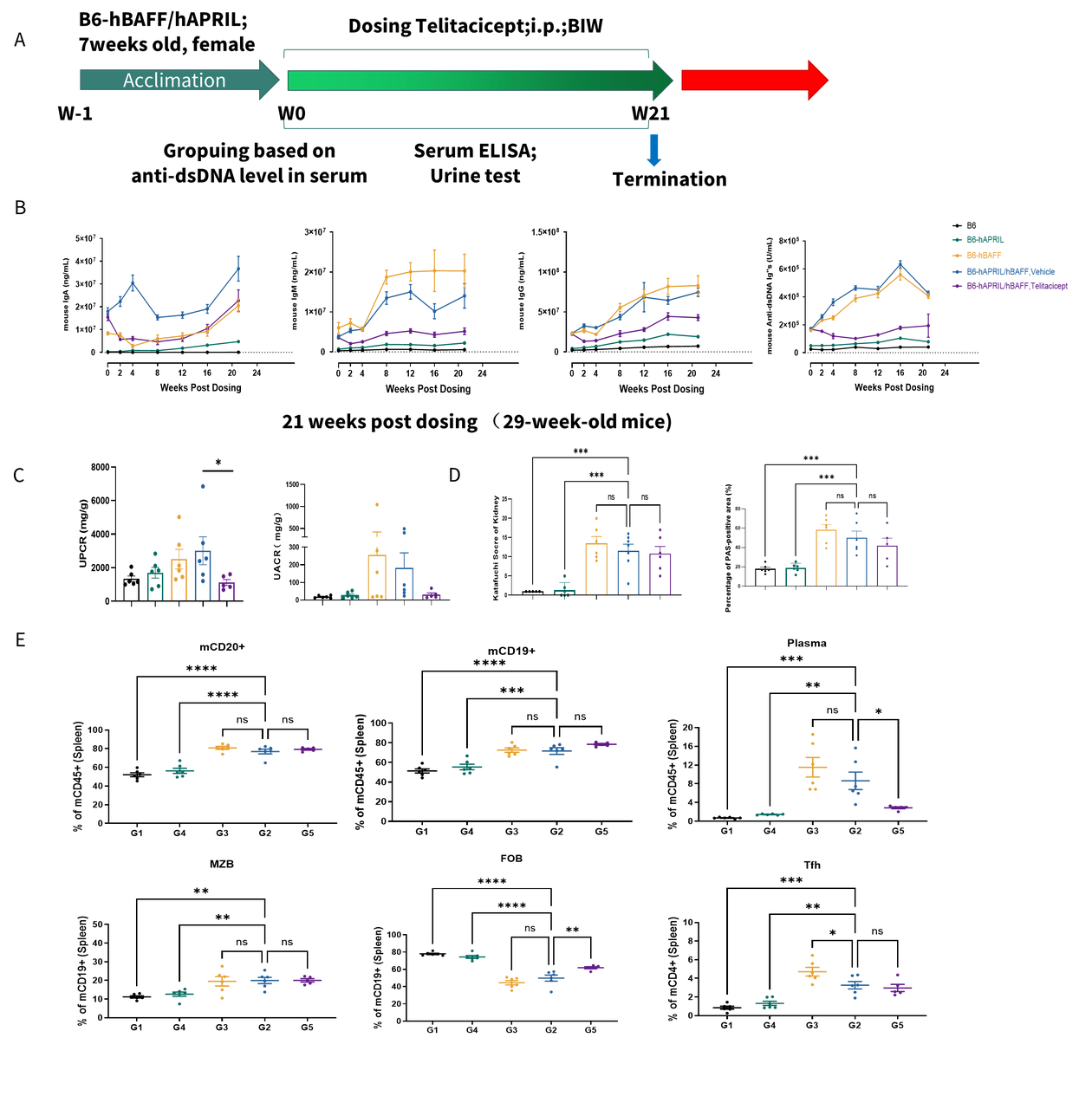 Panel A Overexpression of human BAFF drives spontaneous development of LN and IgAN. We further generated dual humanized APRIL/BAFF mice. Phenotype validation and drug efficacy evaluation were performed according to the study design.
Panel B Double knock-in of human BAFF and APRIL elevates serum IgA and anti-dsDNA IgG levels, while Telitacicept treatment reduces serum antibody levels in B6‑hBAFF/hAPRIL mice.
Panel C Increased proteinuria was observed in B6‑hBAFF and B6‑hBAFF/hAPRIL mice, and Telitacicept treatment ameliorated the renal phenotype in B6‑hBAFF/hAPRIL mice.
Panel D Pathological analysis revealed an increased kidney disease score and expanded PAS‑positive area in B6‑hBAFF and B6‑hBAFF/hAPRIL mice; Telitacicept treatment significantly reduced these parameters.
Panel E An expanded B cell population was found in B6‑hBAFF and B6‑hBAFF/hAPRIL mice, and Telitacicept treatment decreased the plasma B cell population in B6‑hBAFF/hAPRIL mice.
Statistical analysis was performed using one‑way ANOVA, and all data are presented as mean ± SEM. *p<0.05, **p<0.01, ***p<0.001,****p<0.0001.

B6-Cd14-hCD89/hIGHA1
Phenotypic Characterization and Efficacy Study of B6-Cd14-hCD89/hIGHA1 Mice
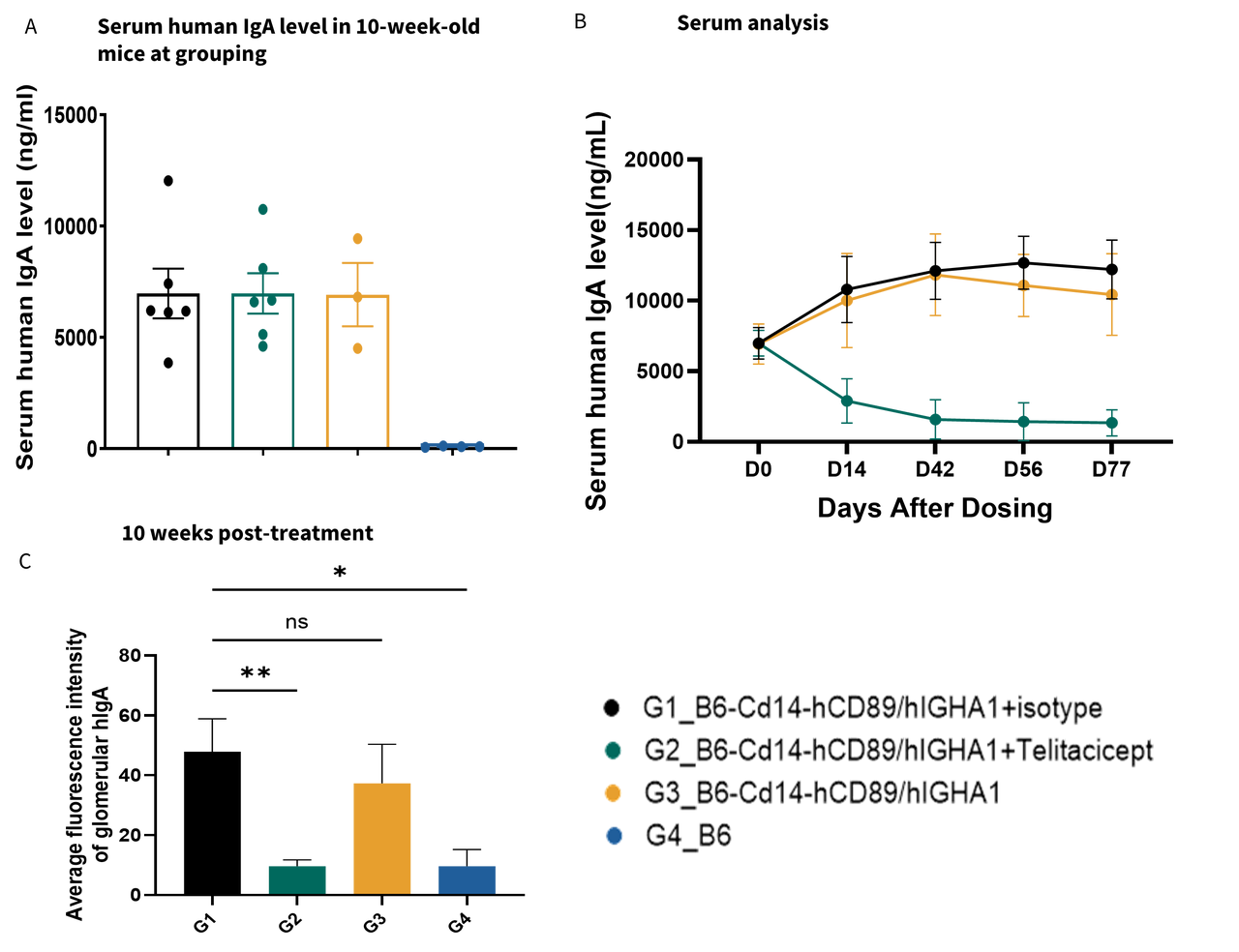 Panel A Human IgA1 and its receptor, human CD89, were expressed in B6 mice, with CD89 expressed in macrophages under the control of the Cd14 promoter. This double-humanized mouse spontaneously develops an IgAN phenotype. The efficacy of telitacicept was evaluated in this strain. Mice were grouped at 10 weeks of age based on serum human IgA levels (A).
Panel B-C Telitacicept treatment reduced serum human IgA levels and renal IgA deposition at 10 weeks post-treatment.
Statistical analysis was performed using one‑way ANOVA, and all data are presented as mean ± SEM. *p<0.05, **p<0.01, ***p<0.001,****p<0.0001.
BSA+CCL4+LPS induced IgAN model
Phenotypic Characterization of BSA+CCL4+LPS induced IgAN model
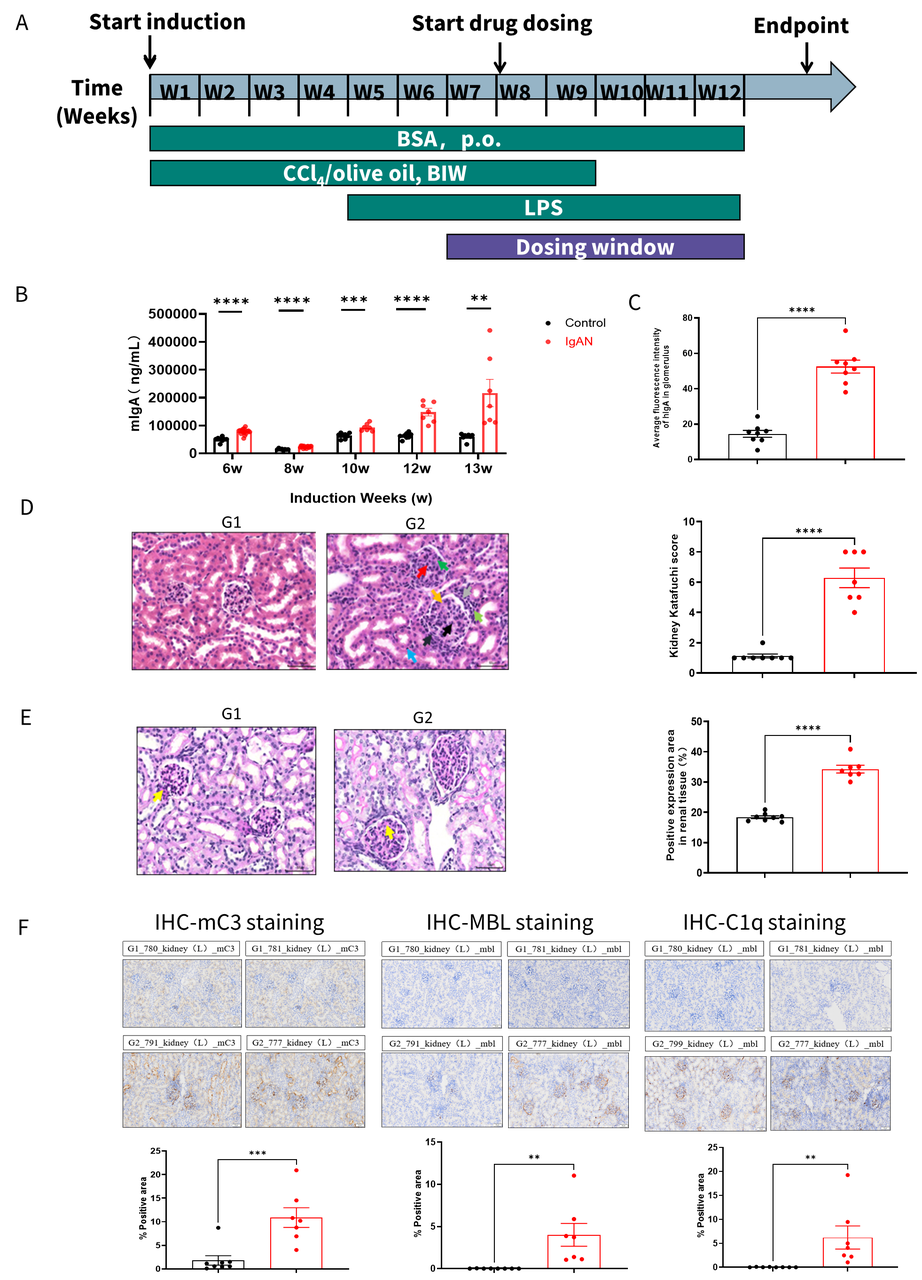
Panel A study design establishing the BSA+CCL₄+LPS-induced IgAN mouse model.
Panel B shows serum IgA levels rose gradually with prolonged modeling duration in the model group.
Panel C displays elevated IgA deposition in renal tissues at the experimental endpoint.
Panel D presents typical renal pathological alterations. The model group exhibited a markedly increased renal Kataguchi score. Key pathological lesions are marked as follows: glomerular basement membrane thickening (gray arrow), mesangial cell proliferation (red arrow), mesangial matrix accumulation (green arrow), glomerular fibrinoid necrosis (orange arrow), necrotic cellular debris (black arrow), crescent formation (brown arrow), lymphocyte infiltration (blue arrow), and fibrous tissue hyperplasia (light green arrow).
Panel E reveals enhanced PAS-positive staining in the model group, with glomerular positive signals marked by yellow arrows.
Panel F confirms positive staining of C3, MBL and C1q in renal tissues of the model group.
Statistical analysis was performed using one‑way ANOVA, and all data are presented as mean ± SEM. *p<0.05, **p<0.01, ***p<0.001,****p<0.0001.
Efficacy Study of BSA+CCL4+LPS induced IgAN model
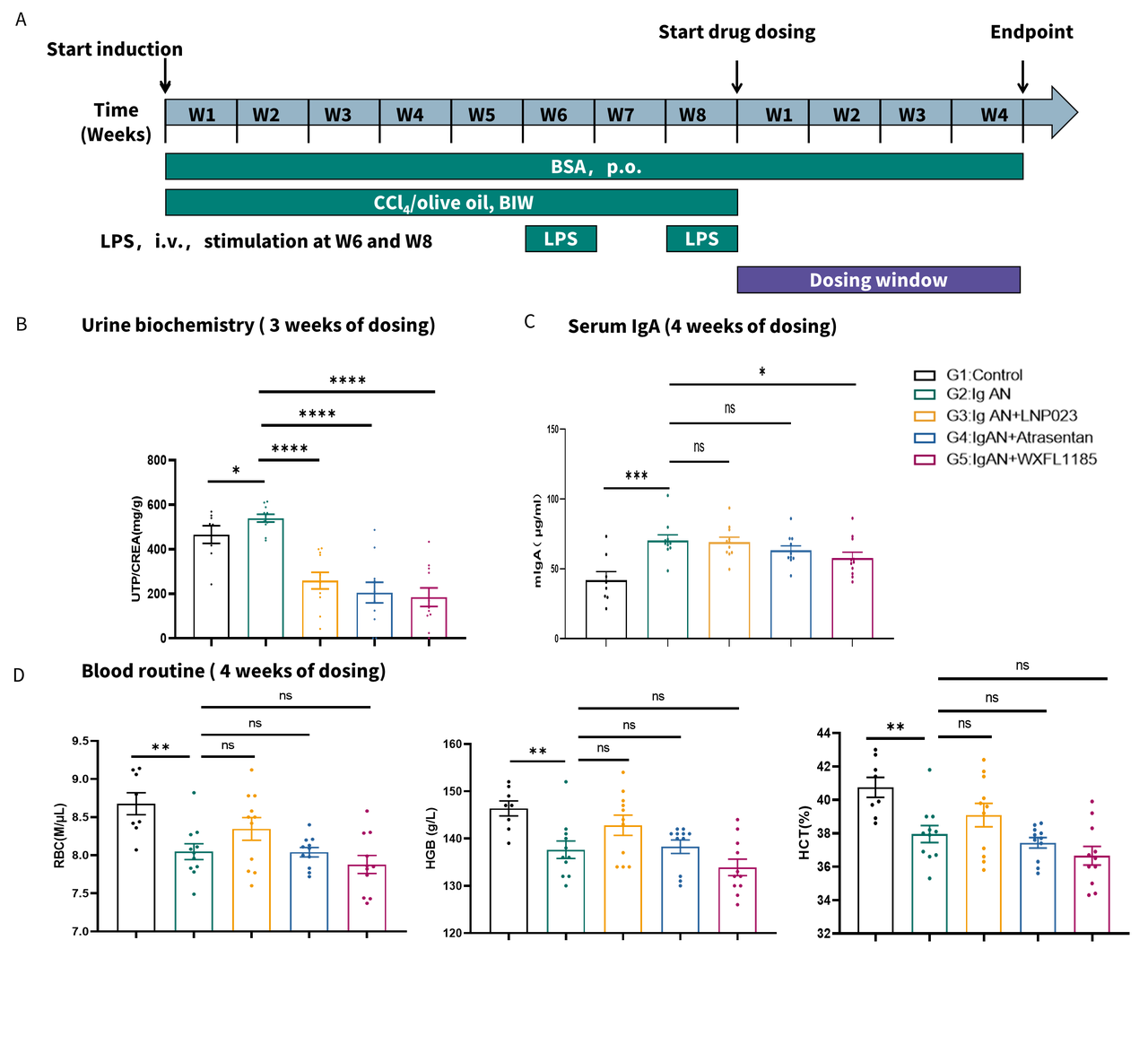 Panel A The overall design of the efficacy evaluation study is displayed here.
Panel B LNP023, atrasentan, and its analogue reduced the UTP/CREA ratio 3 weeks post administration.
Panel C Atrasentan analogue lowered serum IgA levels at 4 weeks after administration.
Panel D The model group exhibited decreased RBC, HGB and HCT, indicating the occurrence of renal anemia. Treatment with LNP023 restored these indicators toward normal levels.
Statistical analysis was performed using one‑way ANOVA, and all data are presented as mean ± SEM. *p<0.05, **p<0.01, ***p<0.001,****p<0.0001
All Product Lines
Browse our comprehensive catalog of over 30,000 mouse models covering various gene families, signaling pathways, and disease models. Use advanced filters to find the perfect model for your research.


- 1
- 2
- 3
- 4
- 5
- 6
- 41
Recommended for You
Discover related models and services to accelerate your research

Accelerate Your Research
Download



Newsletter Signup
'%3e%3cpath%20d='M13.6882%2012L23.6426%202.06059C23.8678%201.83321%2023.9941%201.52611%2023.9941%201.20607C23.9941%200.886035%2023.8678%200.578937%2023.6426%200.351553C23.4152%200.126341%2023.1081%200%2022.7881%200C22.468%200%2022.1609%200.126341%2021.9335%200.351553L11.9941%2010.306L2.05473%200.351553C1.82735%200.126341%201.52025%200%201.20021%200C0.880175%200%200.573077%200.126341%200.345693%200.351553C0.120482%200.578937%20-0.00585938%200.886035%20-0.00585938%201.20607C-0.00585937%201.52611%200.120482%201.83321%200.345693%202.06059L10.3001%2012L0.345693%2021.9394C0.120482%2022.1668%20-0.00585937%2022.4739%20-0.00585938%2022.7939C-0.00585938%2023.114%200.120482%2023.4211%200.345693%2023.6484C0.573077%2023.8737%200.880175%2024%201.20021%2024C1.52025%2024%201.82735%2023.8737%202.05473%2023.6484L11.9941%2013.694L21.9335%2023.6484C22.1666%2023.8397%2022.4624%2023.9374%2022.7635%2023.9226C23.0646%2023.9079%2023.3494%2023.7816%2023.5626%2023.5684C23.7757%2023.3553%2023.902%2023.0704%2023.9168%2022.7694C23.9316%2022.4683%2023.8338%2022.1724%2023.6426%2021.9394L13.6882%2012Z'%20fill='black'%20fill-opacity='0.96'/%3e%3c/g%3e%3cdefs%3e%3cclipPath%20id='clip0_2458_12695'%3e%3crect%20width='24'%20height='24'%20fill='white'/%3e%3c/clipPath%3e%3c/defs%3e%3c/svg%3e)
'%3e%3cpath%20d='M13.6882%2012L23.6426%202.06059C23.8678%201.83321%2023.9941%201.52611%2023.9941%201.20607C23.9941%200.886035%2023.8678%200.578937%2023.6426%200.351553C23.4152%200.126341%2023.1081%200%2022.7881%200C22.468%200%2022.1609%200.126341%2021.9335%200.351553L11.9941%2010.306L2.05473%200.351553C1.82735%200.126341%201.52025%200%201.20021%200C0.880175%200%200.573077%200.126341%200.345693%200.351553C0.120482%200.578937%20-0.00585938%200.886035%20-0.00585938%201.20607C-0.00585937%201.52611%200.120482%201.83321%200.345693%202.06059L10.3001%2012L0.345693%2021.9394C0.120482%2022.1668%20-0.00585937%2022.4739%20-0.00585938%2022.7939C-0.00585938%2023.114%200.120482%2023.4211%200.345693%2023.6484C0.573077%2023.8737%200.880175%2024%201.20021%2024C1.52025%2024%201.82735%2023.8737%202.05473%2023.6484L11.9941%2013.694L21.9335%2023.6484C22.1666%2023.8397%2022.4624%2023.9374%2022.7635%2023.9226C23.0646%2023.9079%2023.3494%2023.7816%2023.5626%2023.5684C23.7757%2023.3553%2023.902%2023.0704%2023.9168%2022.7694C23.9316%2022.4683%2023.8338%2022.1724%2023.6426%2021.9394L13.6882%2012Z'%20fill='%23008077'%20fill-opacity='0.96'/%3e%3c/g%3e%3cdefs%3e%3cclipPath%20id='clip0_2458_12695'%3e%3crect%20width='24'%20height='24'%20fill='white'/%3e%3c/clipPath%3e%3c/defs%3e%3c/svg%3e)
We value your privacy
This website will store cookies on your computer. These cookies are used to collect information about how you interact with this website and enable us to remember you. We use this information to improve and customize your browsing experience, as well as to analyze and collect relevant data and metrics about visitors on this website and other platforms. For more information about the cookies we use, please refer to our privacy policy
If you decline, your information will not be tracked when visiting this website. A cookie will be used in your browser to remember your preference settings that you have not accepted.


Contact Us
Schedule a Meeting
Let us know which event you're attending and we'd be happy to connect with you.