


- By Indication
 Inflammatory and Autoimmune DiseasesRespiratory DiseasesInfectious DiseasesRare DiseaseGut Microbiota Research ServiceBy Modality
 Preclinical Model Strategies for T-Cell Engagers: From Oncology to Autoimmune Disease
 2026-10-27
 11:00 AM ET
 Dr. Wanjun Yuan & Dr. Haiqiao SunOne TCE Modality. Two Disease Contexts. Different Preclinical Questions.
'/%3e%3c/svg%3e)

Multiple Sclerosis (MS)

- 50+HF Models
- 200+Studies Completed
- 15+ND-Enabling Studies
Our Advantages
Industry-leading capabilities for Multiple Sclerosis research

Distinct EAE models covering divergent immune pathogenic mechanisms to match diverse drug targets
We provide two classic MOG-induced EAE models with divergent immune mechanisms for MS research: MOG35-55 EAE features Th1/Th17 T cell-driven pathology, while human MOG1-125 EAE triggers concurrent T/B cell and complement activation to mirror full-spectrum patient immune lesions.
01
Broad-spectrum evaluation capacity across all mainstream therapeutic modalities.
Both EAE models support efficacy assessment across multiple therapeutic modalities, covering the full MS drug pipeline: small molecules (fingolimod, BTK inhibitors), cell therapy (mesenchymal stem cells, MSCs), and therapeutic antibodies.
02
Customizable Study Design
Flexible protocols for acute and chronic heart failure studies, with options for surgical and pharmacological induction.
03
Model Library
Comprehensive Multiple Sclerosis models for preclinical research

Case Studies & Validation Data
Explore our validated Multiple Sclerosis studies demonstrating the efficacy of various therapeutic interventions.
MOG35-55 Induced Experimental Autoimmune Encephalomyelitis (EAE) Model
Efficacy evaluation of a VAV1-degrader 3 in the MOG35-55 induced EAE model using female B6 mice.

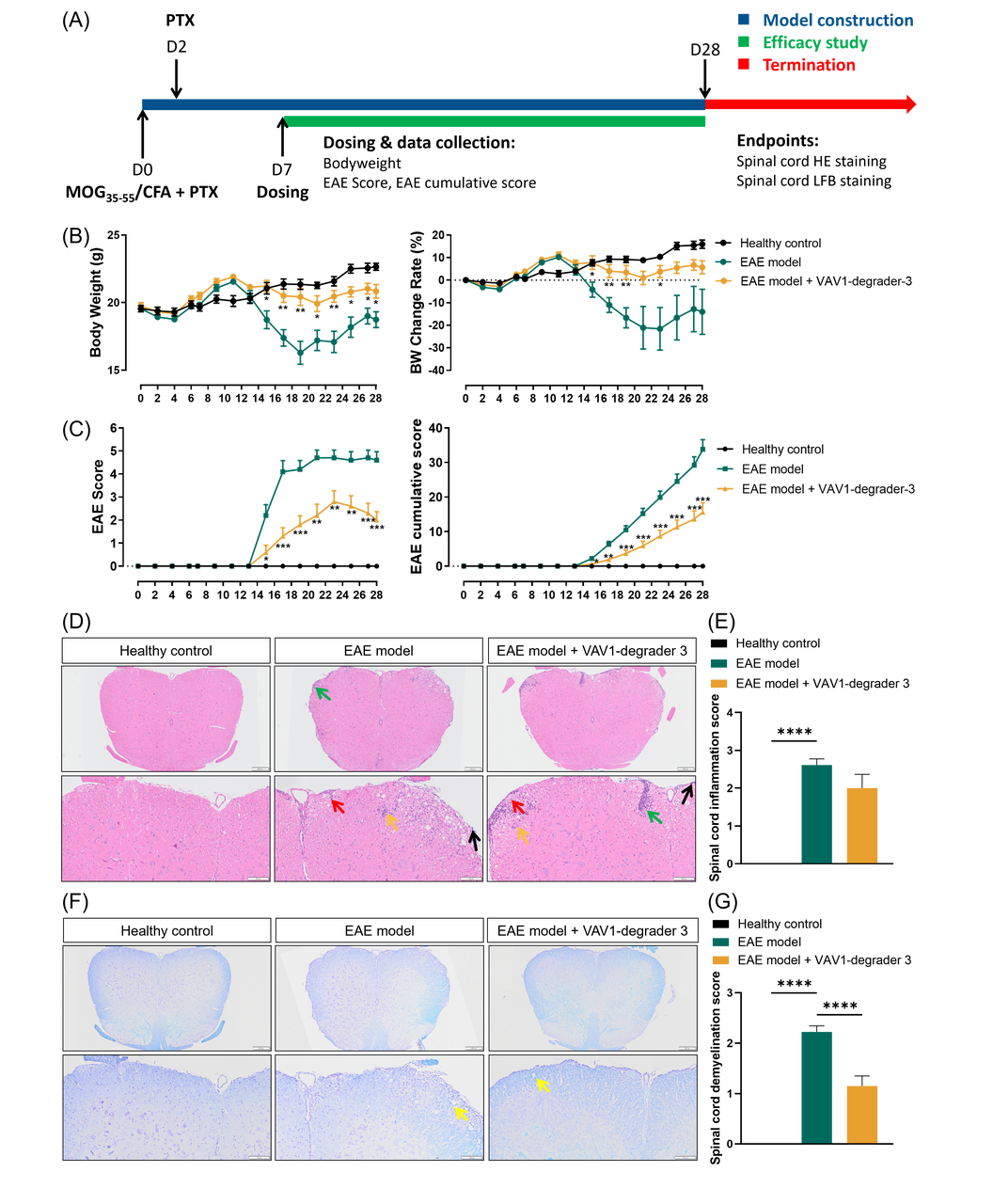
Panel A Study design. EAE model was established by immunization with MOG35-55/CFA and PTX challenge. VAV1-degrader 3 was administered via oral gavage on Day 7.
Panel B VAV1-degrader 3 treatment significantly ameliorated body weight loss and the decrease in body weight percentage compared to the EAE model group.
Panel C VAV1-degrader 3 treatment significantly decreased EAE score and cumilative EAE score compared to the EAE model group.
Panel D Representative H&E-stained spinal cord sections. Note: perivascular cuffing (green arrows), neutrophils (black arrows), mononuclear cells (red arrows), and gliosis (orange arrows). Top row: Scale bar = 200 μm; bottom row: Scale bar = 100 μm.
Panel E VAV1 degrader 3 treatment showed a trend toward lower spinal cord H&E scores relative to the EAE model group.
Panel F Representative LFB-stained spinal cord sections. Note: demyelination (yellow arrows). Top row: Scale bar = 200 μm; bottom row: Scale bar = 100 μm.
Panel G VAV1-degrader 3 treatment significantly reduced spinal cord demyelination scores compared to the EAE model group.
Data are expressed as mean ± standard error (Mean ± SEM), n=8-10. Statistics performed using one-way ANOVA. *P < 0.05; **P < 0.01; ***P < 0.001; ****P < 0.0001.

hMOG1-125 Induced B cell Dependent EAE Model
Efficacy study of Fenebrutinib in the MOG1-125 induced B cell dependent EAE model using female B6 mice
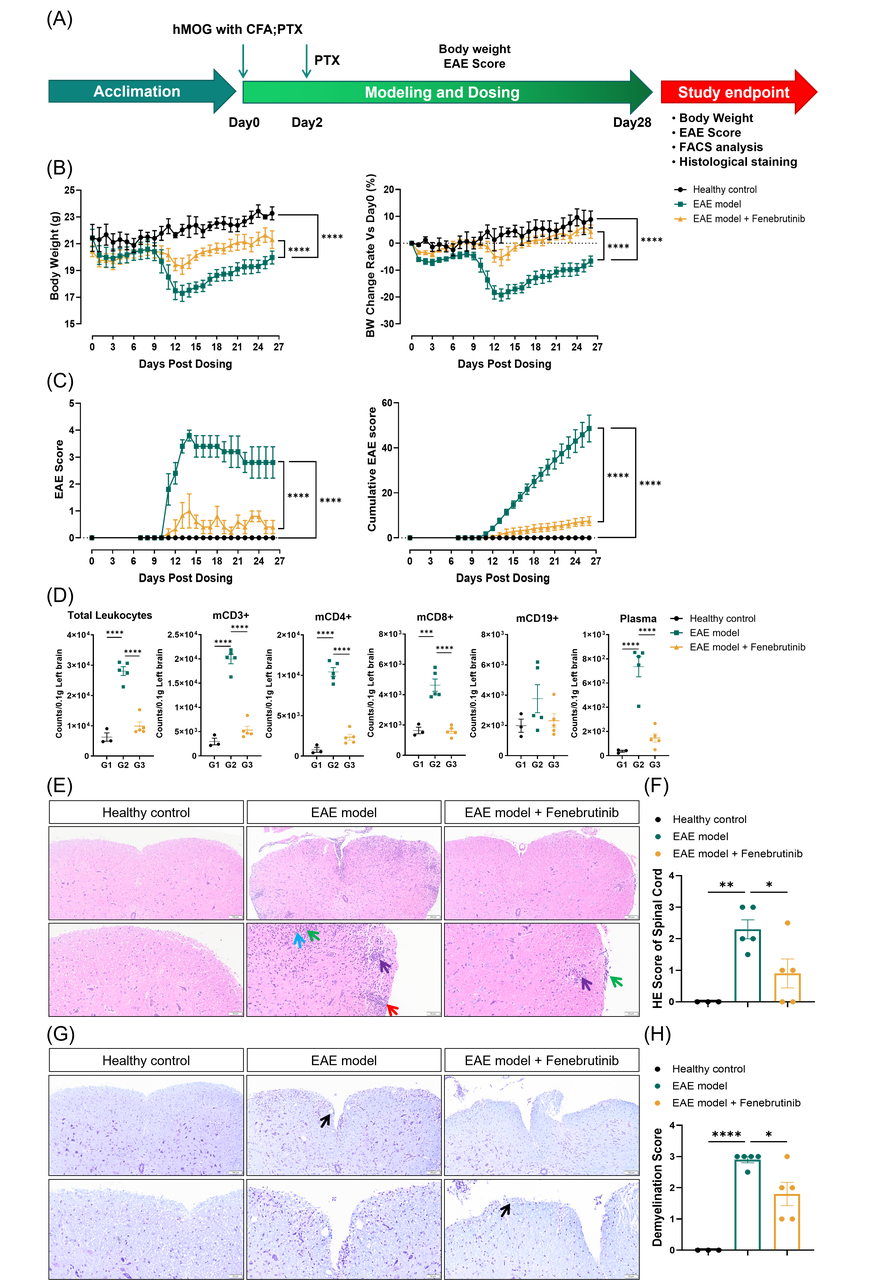
Panel A Study design. The B cell dependent EAE model was established by immunization with human MOG1-125/CFA and PTX challenge. Fenebrutinib, a BTK inhibitor, was administered via intraperitoneal (i.p.) injection on Day 0.
Panel B Fenebrutinib treatment significantly ameliorated body weight loss and the decreased body weight percentage compared to the EAE model group.
Panel C Fenebrutinib treatment significantly decreased EAE score and cumilative EAE score compared to the EAE model group.
Panel D Fenebrutinib treatment significantly inhibited cell number of total leukocytes, T cells, and plasma cells in brain compared to the EAE model group.
Panel E Representative H&E-stained spinal cord sections. Note: vascular cuffs (red arrows), neutrophils (blue arrows), lymphocytes (green arrows), and glial cell hyperplasia (purple arrows).
Panel F Fenebrutinib treatment significantly reduced spinal cord H&E scores compared to the EAE model group.
Panel G Representative LFB-stained spinal cord sections. Note: demyelination of nerve fibers (black arrows).
Panel H Fenebrutinib treatment significantly reduced spinal cord demyelination scores compared to the EAE model group.
Data are expressed as mean ± standard error (Mean ± SEM), n=3-5. Statistics performed using One-way ANOVA. *, P < 0.05; **, P < 0.01; ***, P < 0.001; ****, P < 0.0001.
All Product Lines
Browse our comprehensive catalog of over 30,000 mouse models covering various gene families, signaling pathways, and disease models. Use advanced filters to find the perfect model for your research.


- 1
- 2
- 3
- 4
- 5
- 6
- 8
Recommended for You
Discover related models and services to accelerate your cardiovascular research



Ready to Start Your Custom Model Project?
Download



Newsletter Signup


We value your privacy
This website will store cookies on your computer. These cookies are used to collect information about how you interact with this website and enable us to remember you. We use this information to improve and customize your browsing experience, as well as to analyze and collect relevant data and metrics about visitors on this website and other platforms. For more information about the cookies we use, please refer to our privacy policy
If you decline, your information will not be tracked when visiting this website. A cookie will be used in your browser to remember your preference settings that you have not accepted.
Contact Us
Schedule a Meeting
Let us know which event you're attending and we'd be happy to connect with you.