


- By Indication
 Inflammatory and Autoimmune DiseasesRespiratory DiseasesInfectious DiseasesRare DiseaseGut Microbiota Research ServiceBy Modality
 Preclinical Model Strategies for T-Cell Engagers: From Oncology to Autoimmune Disease
 2026-10-27
 11:00 AM ET
 Dr. Wanjun Yuan & Dr. Haiqiao SunOne TCE Modality. Two Disease Contexts. Different Preclinical Questions.
'/%3e%3c/svg%3e)
Hyperuricemia

- 3Validated Models
- 50+Studies Completed
Our Advantages

Clinically Relevant Models
Congenital UOX loss, inducible Uox deletion, and rapid chemical induction models match different clinical mechanisms and biomarkers.
01
Comprehensive Readouts
Integrated endpoints include serum UA, urinary UA, UACR, CREA, BUN, ALT/AST, hematology, and kidney HE/Masson staining.
02
Flexible Study Design
Supports severe hyperuricemia, chronic longitudinal studies, urate transport and excretion studies, and short-cycle efficacy screening
03
Model Library

Case Studies & Validation Data
Explore our validated hyperuricemia studies demonstrating the efficacy of various therapeutic interventions.
Renal Impairment in UOX-KO Mice
Spontaneous Hyperuricemia and Renal Impairment in UOX-KO mice

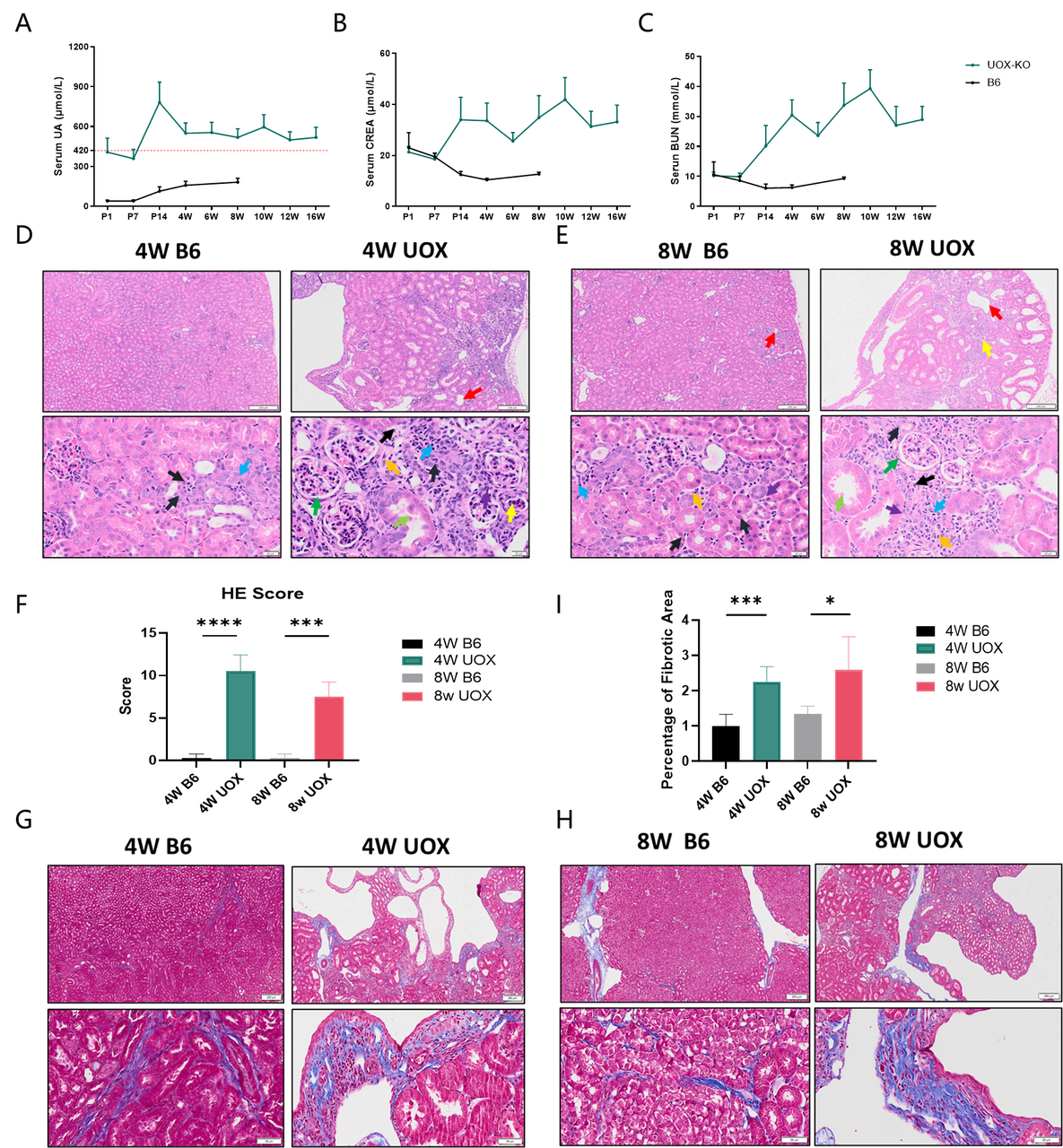
UOX-KO mice exhibit markedly elevated serum uric acid from an early age, accompanied by increased CREA, BUN, and urinary uric acid levels. Renal histopathology further indicates the presence of spontaneous kidney injury and fibrosis.
(A–C) Changes in serum uric acid (UA), serum creatinine (CREA), and blood urea nitrogen (BUN) levels in the two groups of mice at different time points.(D) Representative H&E-stained kidney sections from the two groups at 4 weeks of age, showing more pronounced renal tissue injury in the UOX-KO group; colored arrows indicate representative pathological alterations.(E) Representative H&E-stained kidney sections from the two groups at 8 weeks of age, showing more pronounced renal tissue injury in the UOX-KO group; colored arrows indicate representative pathological alterations.(F) Quantitative analysis of renal pathological changes in the two groups at 4 and 8 weeks of age. Colored arrows indicate representative pathological alterations.(G) Representative Masson-stained kidney sections from the two groups at 4 weeks of age. (H) Representative Masson-stained kidney sections from the two groups at 8 weeks of age, used to assess renal interstitial collagen deposition and fibrotic changes. (I) Quantification of the renal fibrotic area percentage in the two groups at 4 and 8 weeks of age.

Rapid Induction of Hyperuricemia Model
Hypoxanthine + Potassium Oxonate Induced Rapid Induction Mode
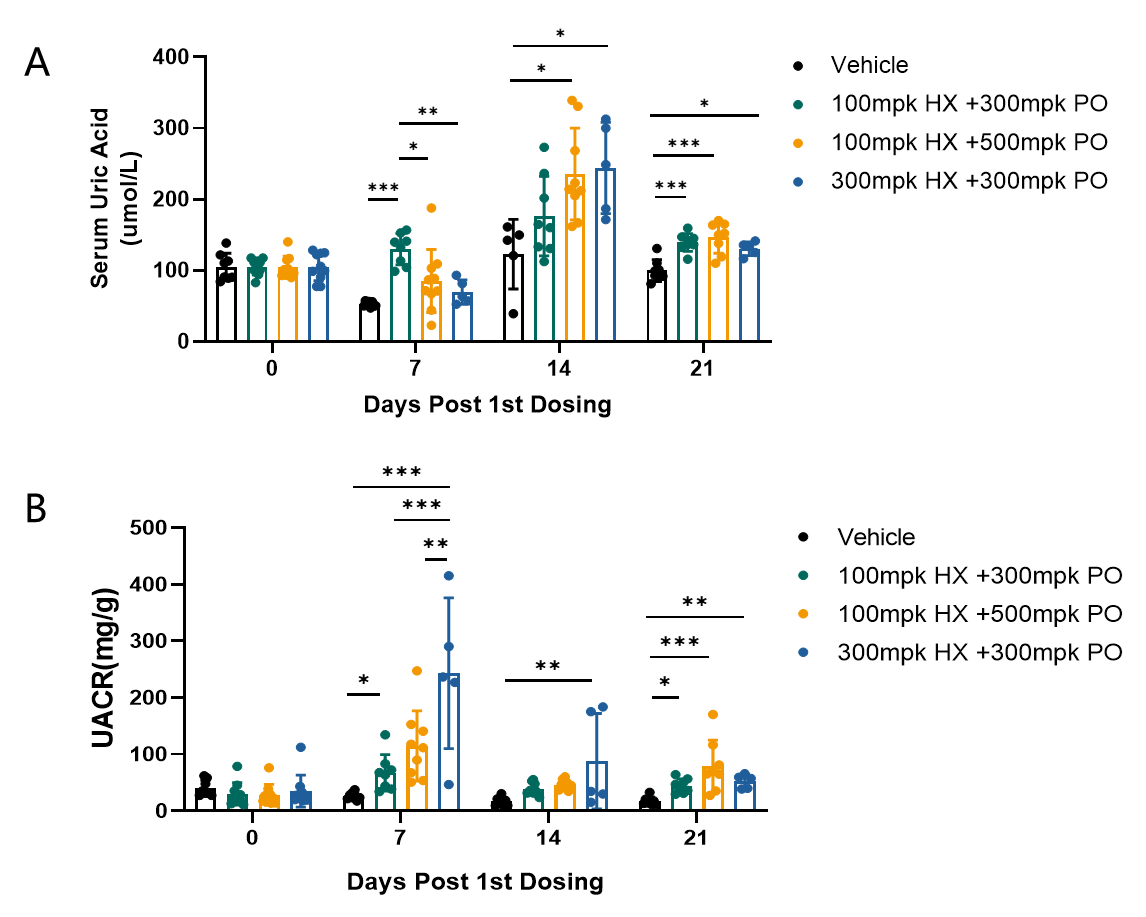
Hypoxanthine (HX) combined with potassium oxonate (PO) rapidly induces a hyperuricemia model with elevated serum uric acid and renal injury-related changes. This model is convenient, time-efficient, and suitable for early pharmacological evaluation of hyperuricemia and related renal complications.
(A) Serum uric acid levels in mice from different groups at the indicated time points; (B) urinary albumin-to-creatinine ratio (UACR) at the indicated time points. HX+PO treatment effectively elevated serum uric acid and was accompanied by renal injury-related changes. n=5-8 , Data presented as mean ± SD.
Inducible Uox-KO Model & Allopurinol Intervention
Tamoxifen-inducible Uox-flox/Rosa26-SA-CreERT2 hyperuricemia model and allopurinol intervention.
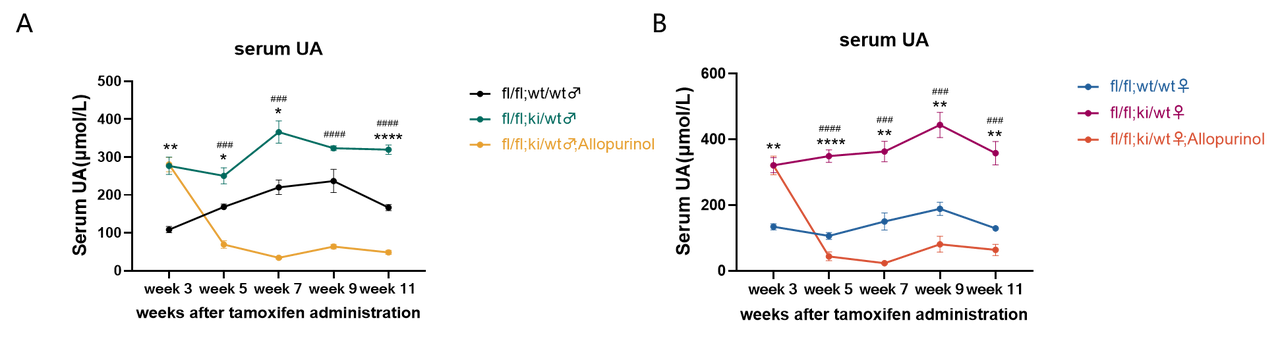 Following tamoxifen induction, conditional Uox-deficient mice developed a marked increase in serum uric acid, indicating successful establishment of a hyperuricemia-like phenotype. Treatment with allopurinol significantly reduced serum uric acid levels in the Uox-deficient mice, demonstrating good responsiveness to a classical urate-lowering agent and supporting the utility of this model for pharmacological and mechanistic studies of hyperuricemia.
(A) Serum uric acid levels in male mice at different time points.(B) Serum uric acid levels in female mice at different time points.Serum uric acid increased after tamoxifen induction and was reduced by allopurinol treatment. n=5, Data presented as mean ± SEM.
Product Lines


- 1
- 2
- 3
- 4
- 5
- 6
- 12
Recommended for You
Discover related models and services to accelerate your research

Accelerate Your Research
Download



Newsletter Signup


We value your privacy
This website will store cookies on your computer. These cookies are used to collect information about how you interact with this website and enable us to remember you. We use this information to improve and customize your browsing experience, as well as to analyze and collect relevant data and metrics about visitors on this website and other platforms. For more information about the cookies we use, please refer to our privacy policy
If you decline, your information will not be tracked when visiting this website. A cookie will be used in your browser to remember your preference settings that you have not accepted.


Contact Us
Schedule a Meeting
Let us know which event you're attending and we'd be happy to connect with you.