


- By Indication
 Inflammatory and Autoimmune DiseasesRespiratory DiseasesInfectious DiseasesRare DiseaseGut Microbiota Research ServiceBy Modality
 Preclinical Model Strategies for T-Cell Engagers: From Oncology to Autoimmune Disease
 2026-10-27
 11:00 AM ET
 Dr. Wanjun Yuan & Dr. Haiqiao SunOne TCE Modality. Two Disease Contexts. Different Preclinical Questions.
'/%3e%3c/svg%3e)

Parkinson's Disease (PD)

- 50+Mouse Models Related to Neurological Diseases
- 500+Studies Completed
- 10+ND-Enabling Studies
Our Advantages

Clinically Relevant Models
Our PD models faithfully replicate key pathological features of Parkinson's disease, including dopaminergic neuron degeneration in the substantia nigra, decreased dopamine secretion in the striatum, and α-synuclein aggregation — providing clinically predictive platforms for drug efficacy evaluation.
01
Comprehensive Assessment
We offer a full spectrum of behavioral and biochemical assessments — rotarod, grip strength, gait analysis, neurochemical analysis, and histopathology — to comprehensively characterize drug effects across all PD models.
02
Customizable Study Design
From model selection to experimental endpoints, our team works closely with sponsors to tailor study protocols that align with specific research goals and regulatory requirements for Parkinson's disease therapies.
03
Model Library

Case Studies & Validation Data
AAV-GDNF Therapeutic Efficacy
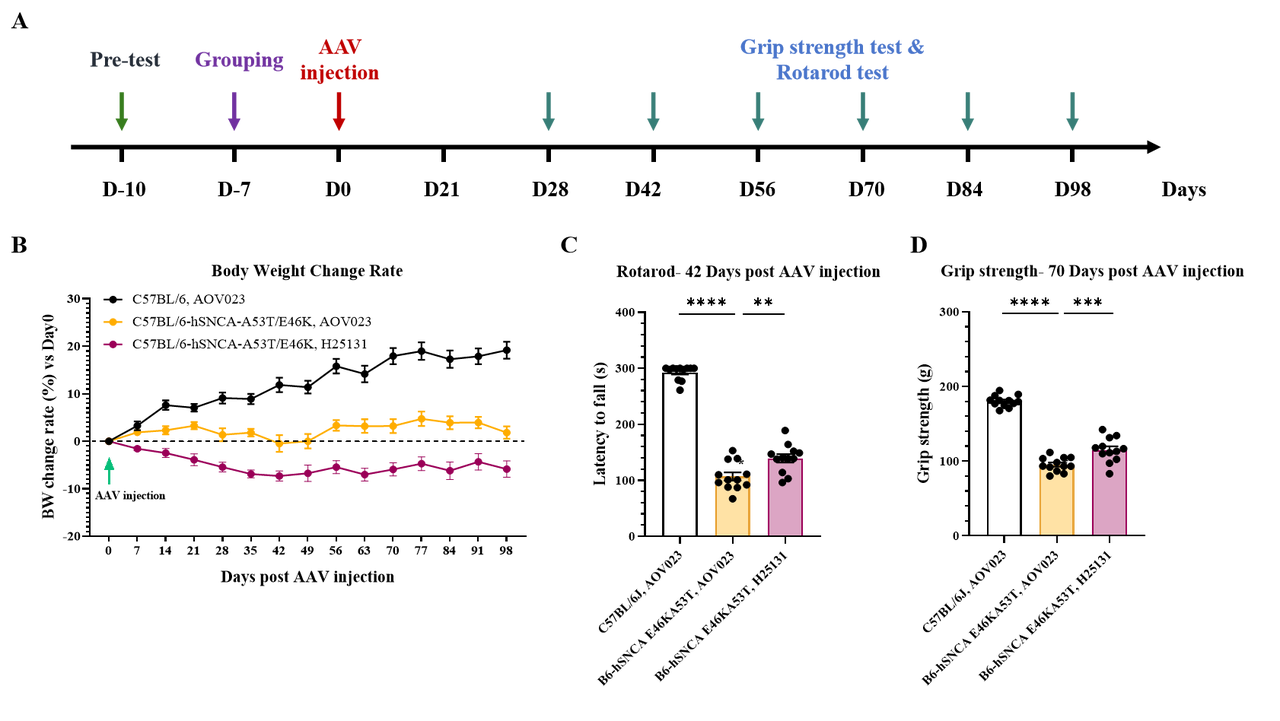
AAV-GDNF Treatment Improves Limb Muscle Strength and Motor Coordination in B6-hSNCA A53T/E46K Mice

AAV-GDNF Treatment Improves Limb Muscle Strength and Motor Coordination in B6-hSNCA A53T/E46K Mice
Panel A: Experimental design of AAV virus injection to assess therapeutic effects on motor function.
Panel B: Body weight changes in B6-hSNCA E46K/A53T mice following AAV virus injection.
Panel C: Changes in limb grip strength of B6-hSNCA E46K/A53T mice 42 days after virus injection.
Panel D: Changes in latency to fall during the rotarod test 70 days after virus injection.
Data are presented as Mean ± SEM (n = 12/group). Statistical significance: *P < 0.05, **P < 0.01, ***P < 0.001, ****P < 0.0001; One-way ANOVA.

6-OHDA-Induced PD Mouse Model
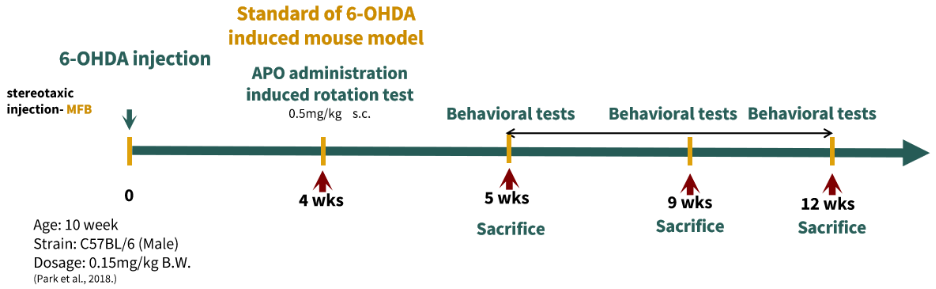
Experimental Design
4 weeks after unilateral stereotaxic injection of 6-OHDA, subcutaneous injection of apomorphine (0.5 mg/kg) will cause mice to rotate toward the uninjured side. Mice that rotate more than 120 times (4 turns/minute) within 30 minutes can be identified as PD models.
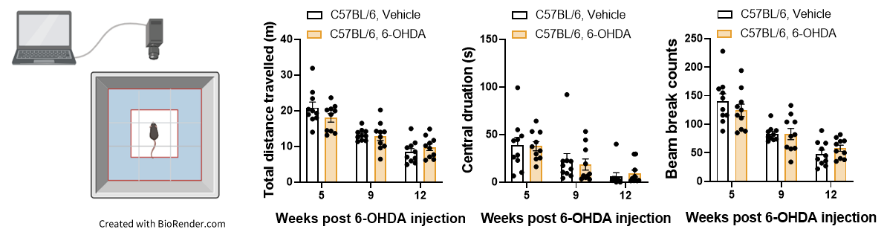
2. Behavioral Test-- Open Field Test
PD mice did not show decreased locomotor activity and anxiety-like behavior in the open field test.
n=10 mice/group. Data are represented as mean ± SEM. T-test was performed to determine the statistical significance between 2 groups. *P<0.05,**P<0.01,***P<0.001,****P<0.0001. P<0.05 was considered statistically significant.
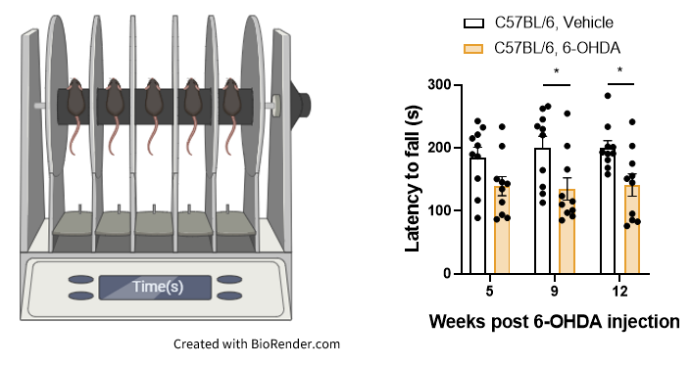
3. Behavioral Test - Rotarod
PD mice showed deficits in motor learning and motor coordination in the rotarod test.
n=10 mice/group. Data are represented as mean ± SEM. T-test was performed to determine the statistical significance between 2 groups. *P<0.05,**P<0.01,***P<0.001,****P<0.0001. P<0.05 was considered statistically significant.
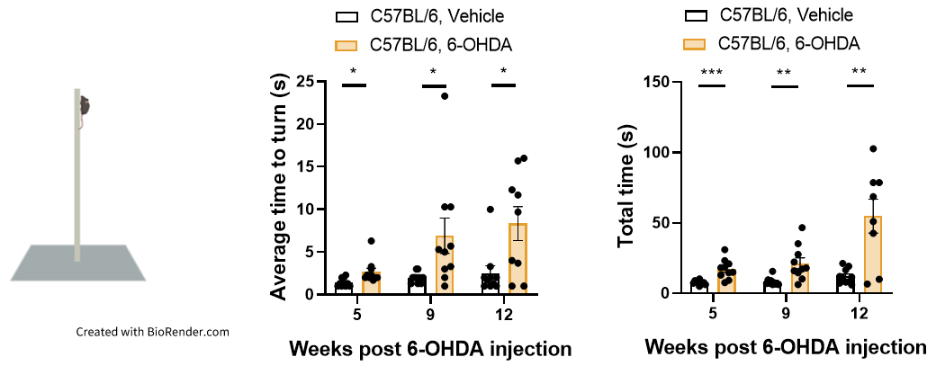
4. Behavioral Test - Pole Test
PD mice showed bradykinesia and reduced motor coordination in the pole test.
n=10 mice/group. Data are represented as mean ± SEM. T-test was performed to determine the statistical significance between 2 groups. *P<0.05,**P<0.01,***P<0.001,****P<0.0001. P<0.05 was considered statistically significant.
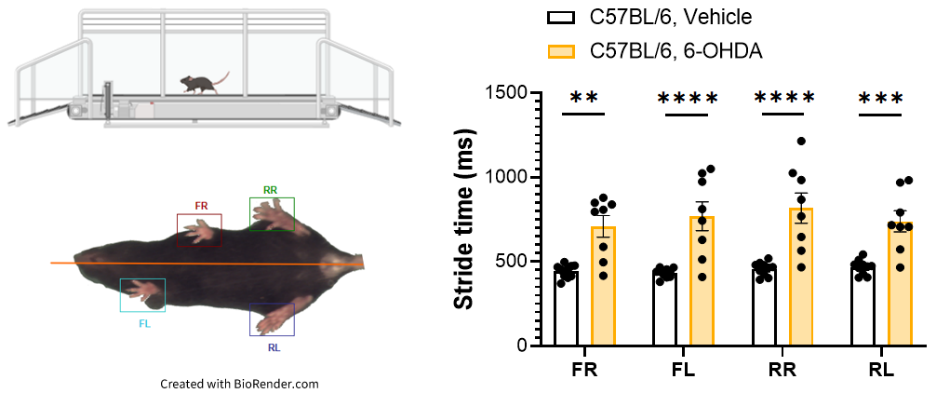
5. Behavioral Test - Gait Analysis
4 weeks after 6-OHDA injection, gait analysis showed that PD mice exhibited significant bradykinesia.
n=8-10 mice/group. Data are represented as mean ± SEM. T-test was performed to determine the statistical significance between 2 groups. *P<0.05,**P<0.01,***P<0.001,****P<0.0001. P<0.05 was considered statistically significant.
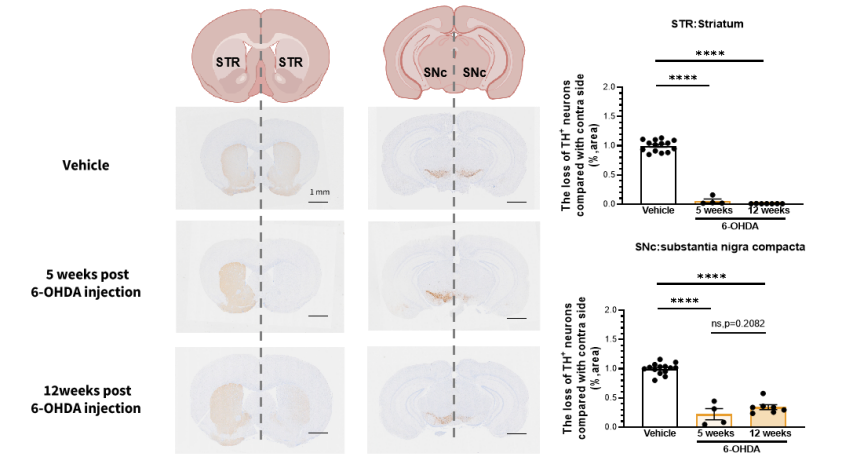
6. Pathology-- TH(+) Neurons in the Substantia Nigra and Striatum
5, 9, and 12 weeks after 6-OHDA injection, TH(+) neuron loss was observed in the striatum and substantia nigra on the injured side of PD mice.
n=4-10 mice/group. Data are represented as mean ± SEM. T-test was performed to determine the statistical significance between 2 groups. *P<0.05,**P<0.01,***P<0.001,****P<0.0001. P<0.05 was considered statistically significant.
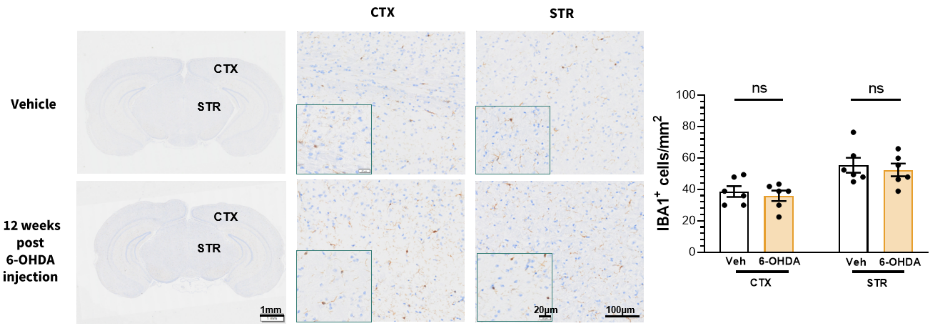
7. Pathology-- Number of IBA1(+) Microglia in the Cortex and Striatum
No significant increase in the number of IBA1(+) microglia in the cortex and striatum of PD mice.
n=6 mice/group. Data are represented as mean ± SEM. T-test was performed to determine the statistical significance between 2 groups. *P<0.05,**P<0.01,***P<0.001,****P<0.0001. P<0.05 was considered statistically significant.
All Product Lines


- 1
- 2
- 3
- 4
- 5
- 6
- 8
Recommended for You
Discover related models and services to accelerate your cardiovascular research

Ready to Accelerate Your Research?
Download



Newsletter Signup


We value your privacy
This website will store cookies on your computer. These cookies are used to collect information about how you interact with this website and enable us to remember you. We use this information to improve and customize your browsing experience, as well as to analyze and collect relevant data and metrics about visitors on this website and other platforms. For more information about the cookies we use, please refer to our privacy policy
If you decline, your information will not be tracked when visiting this website. A cookie will be used in your browser to remember your preference settings that you have not accepted.


Contact Us
Schedule a Meeting
Let us know which event you're attending and we'd be happy to connect with you.