


'/%3e%3c/svg%3e)

- By Indication
 Inflammatory and Autoimmune DiseasesRespiratory DiseasesInfectious DiseasesRare DiseaseGut Microbiota Research ServiceBy Modality
 Preclinical Model Strategies for T-Cell Engagers: From Oncology to Autoimmune Disease
 2026-10-27
 11:00 AM ET
 Dr. Wanjun Yuan & Dr. Haiqiao SunOne TCE Modality. Two Disease Contexts. Different Preclinical Questions.
'/%3e%3c/svg%3e)
'/%3e%3c/svg%3e)

Oncology
Development of a Novel NCG-hIL15-FcγR-KO Model for Precise Drug Efficacy Evaluation
 2025-05-01

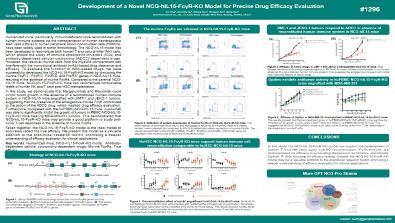

Humanized mice, particularly immunodeficient mice reconstituted with human immune systems via the transplantation of human hematopoietic stem cells (HSCs) or human peripheral blood mononuclear cells (PBMCs), have been widely used in tumor immunology. The NCG-hIL15 model has been developed to reconstitute both human T and natural killer (NK) cells, which allows the study of immune checkpoint inhibitors (ICIs) and antibody-dependent cellular cytotoxicity (ADCC)-dependent drugs. However, the residual murine cells from the myeloid compartment can interfere with the monoclonal antibody (mAb)-based drug clearance and efficacy. To evaluate the function of mAb-based drugs, we have successfully developed the NCG-hIL15-FcγR-KO model by disrupting the murine FcγRⅠ, FcγRⅡ, FcγRⅢ, and FcγRⅣ genes in NCG-hIL15 mice, resulting in the absence of murine FcγRs. Compared to the parental NCG-hIL15 mice, NCG-hIL15-FcγR-KO mice can reconstitute comparable levels of human NK and T cells post-HSC transplantation.
Recommended for You
More infomation about blogs




Find Models



Submit Inquiry
Contact Us
Schedule a Meeting
Let us know which event you're attending and we'd be happy to connect with you.
Download
Download
Watch On-Demand Webinar
Newsletter Signup

We value your privacy
This website will store cookies on your computer. These cookies are used to collect information about how you interact with this website and enable us to remember you. We use this information to improve and customize your browsing experience, as well as to analyze and collect relevant data and metrics about visitors on this website and other platforms. For more information about the cookies we use, please refer to our privacy policy
If you decline, your information will not be tracked when visiting this website. A cookie will be used in your browser to remember your preference settings that you have not accepted.