
Preclinical evaluation of the B7-H3 antibody in a humanized mouse model
June 15, 2024


Preclinical evaluation of the B7-H3 antibody in a humanized mouse model
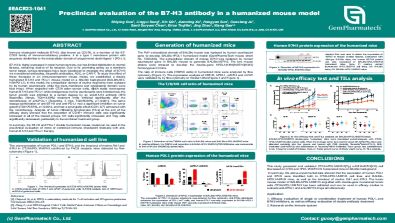
Immune checkpoint molecule B7-H3, also known as CD276, is a member of the B7-CD28 family of immunomodulatory proteins. It is a type I membrane protein with sequence similarities to the extracellular domain of programmed death-ligand 1 (PD-L1). B7-H3 is highly expressed in most human cancers, but has limited distribution in normal tissues, remaining elusive of its receptor. Due to its promising safety as a dominant tumor target, various strategies have been developed to modulate the effect of B7-H3 via monoclonal antibodies, bispecific antibodies, ADC, or CAR-T. To study the effect of these therapies in an immunocompetent mouse model, we established a double humanized B7-H3 and PD-L1 mouse model on a BALB/c background (BALB/c-hB7-H3/hPD-L1).
In this model, the extracellular domain of murine fragments were replaced by its human counterparts while the trans-membrane and cytoplasmic domain were kept intact. When engrafted with CT26 colon cancer cells, which stably overexpress human B7-H3 and PD-L1 while endogenous murine counterparts were knocked out, the tumor growth was inhibited to a certain degree by anti-B7-H3 antibody (8H9 Biosimilar, 20mpk, TGI=18.56%) treatment while inhibited significantly after the monotherapy of anti-PD-L1 (Tecentriq, 3 mpk, TGI=55.89%, p<0.001). The same dosage combination of anti-B7-H3 and anti-PD-L1 had a significant inhibition on tumor growth (TGI=76.85%, p<0.001), and had a synergistic effect (CDI<0.7) compared with the monotherapy.
Analysis of tumor infiltrating lymphocytes (TILs) at the end of the efficacy study showed that the proportion of CD45+ immune cells was significantly increased in all of the treated groups. NK cells significantly increased and Treg cells significantly decreased, particularly in the combined treatment group.
In summary, the B7-H3 and PD-L1 double humanized mouse model can be used in the pre-clinical evaluation of mono or combined immune checkpoint blockade with anti-human B7-H3 and PD-L1 therapy.
Download
In this model, the extracellular domain of murine fragments were replaced by its human counterparts while the trans-membrane and cytoplasmic domain were kept intact. When engrafted with CT26 colon cancer cells, which stably overexpress human B7-H3 and PD-L1 while endogenous murine counterparts were knocked out, the tumor growth was inhibited to a certain degree by anti-B7-H3 antibody (8H9 Biosimilar, 20mpk, TGI=18.56%) treatment while inhibited significantly after the monotherapy of anti-PD-L1 (Tecentriq, 3 mpk, TGI=55.89%, p<0.001). The same dosage combination of anti-B7-H3 and anti-PD-L1 had a significant inhibition on tumor growth (TGI=76.85%, p<0.001), and had a synergistic effect (CDI<0.7) compared with the monotherapy.
Analysis of tumor infiltrating lymphocytes (TILs) at the end of the efficacy study showed that the proportion of CD45+ immune cells was significantly increased in all of the treated groups. NK cells significantly increased and Treg cells significantly decreased, particularly in the combined treatment group.
In summary, the B7-H3 and PD-L1 double humanized mouse model can be used in the pre-clinical evaluation of mono or combined immune checkpoint blockade with anti-human B7-H3 and PD-L1 therapy.